
Reflective Practioner
Reflective Practitioner
Effective urban educators are Reflective Practitioners who can accurately assess themselves and develop plans for improvement.
I am a reflective practitioner. Becoming an amazing teacher takes time. Knowing how to reflect on and improve my professional development is important to better my future classrooms. Even though I put everything into my days and have amazing days, I always try to reflect and ask myself, "what did I do that made this day amazing." And when I don't have great days, I ask myself, "what can I change to avoid this happening again" or "how can I plan better to change what happened." Just like how students are always learning, teachers should always be learning and growing to improve themselves.
Reflecting Evidence

The picture on the left is an example of a students writing from September and the picture on the right is the same student but from November. In both they are given a topic and have to write about it for a week, adding more detail as the week goes on. As you can see in the first picture, they wrote about a page and didn't add anymore detail to their writing but instead to the drawing. In the second picture, you see the student steering away from the drawing, and adding more detail to their writing. Although we see misspelled words in their writing, we also encourage kids to sound out their words and to do their best. In first grade, the students are more focused on adding details rather than the spelling.
Reflecting on these two writing pieces, the students are showing me that as we continue to encourage them they are adding more detail and they are starting to build up that writing stamina. I also see as we are writing which students need the additional support, whether that be in a small group or with other interventionists that we have in the building.

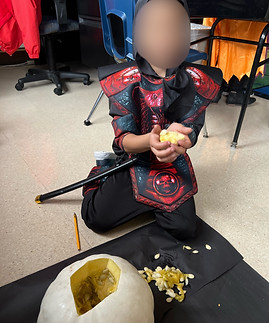
In this activity, students were pulling seeds out of a pumpkin. With this they were learning how to make an educated guess based on how many seeds they thought they saw in the pumpkin and counting by 5s. When the students were pulling seeds out they were putting them in groups of 5 and once we got to 50 we had them make another guess. At the end we showed them how many groups of 5 we had an had them count by 5s. Some students needed help with this so we also had a number chart on the smart board.
Reflecting on this activity, I know the students had a fun time doing something different rather than doing the math in their math books. I know which students are having a harder time with counting by 5s and making sure they are getting into small groups to get that extra help.